Monk Took Book Review
Who the abbey is for, what it asks of your memory, and what launch actually delivered.
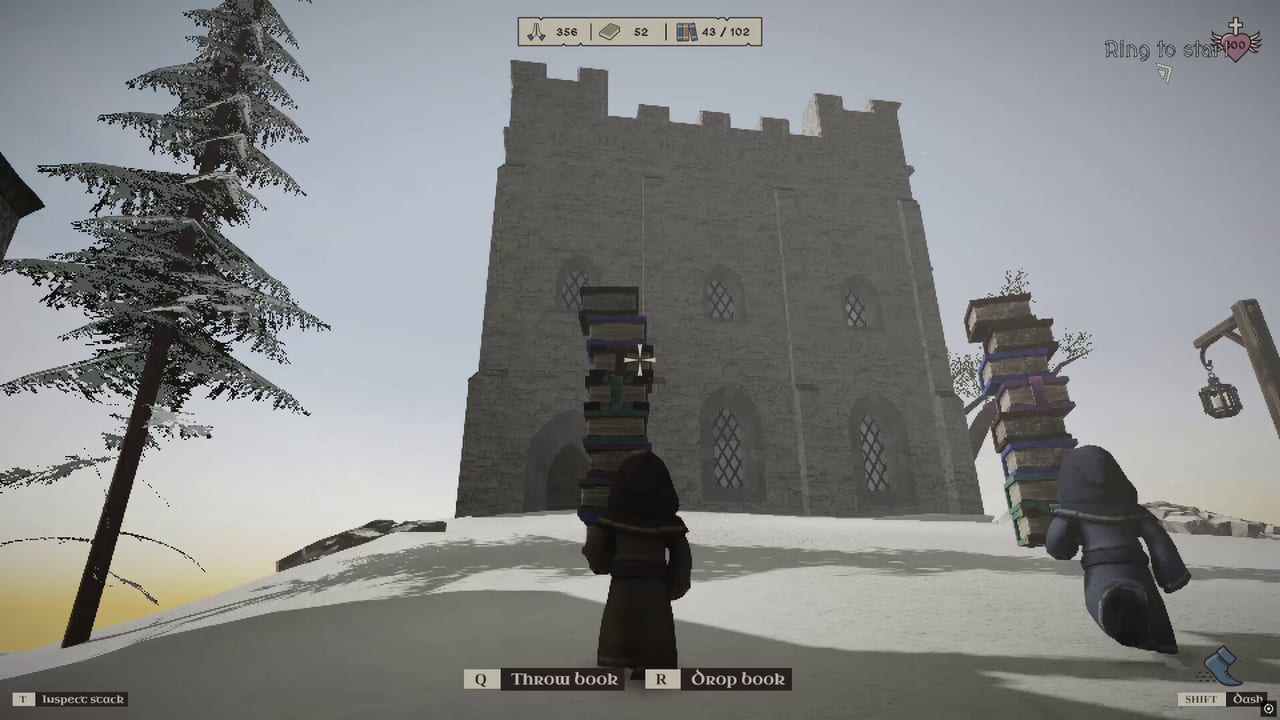
Monk Took Book, from SquarePlay Games, launched on Steam for PC on 3 September 2026. It is a 1–4 player online co-op library sim set on Holy Island: haul untitled illustrated books by day, ring the belfry, and fill scribe orders by night while optional hauntings try to steal the hourglass. It is not Roblox. It is not a 40-hour action RPG. It is a memory toy with physics, fire, and a monastic coat of paint.
This is a player-facing review, not a recap of the walkthrough. If you want the loop taught gently, use Getting Started. If you want a buy/skip read that does not pretend every night is magic, stay here.
Who it is for
You will like Monk Took Book if the phrase “I put the lion covers on the left and I can still find them at 4 a.m.” sounds like a good time. The pleasure is taxonomic. Covers have pictures and no titles. You invent the Dewey Decimal System with worse lighting. When a night order matches a family you actually remember, the abbey clicks.
You will like it more with two or three friends who can follow a spoken rule. Throws across the hall, a shared ladder, a pail passed toward a spark — that is the joke the trailer sells, and it is real. You will like the hauntings if you want rats, rabbit archers, and Viking Draugr as spice, not as the meal.
You will bounce if you wanted a deep combat progression, a story dungeon, or a game that plays itself while you listen to a podcast. The Abbot does not narrate a plot that saves a bad taxonomy. If your group cannot agree on where geometry books live, co-op becomes four people shouting in a beautiful room.
Memory is the difficulty slider
The honest criticism, and the honest praise, is the same sentence: the game asks you to remember pictures. Early nights are two covers and a tutorial bell. A few deliveries later you are staring at a hall of families, a tapestry of types, and a checkout list that does not care that you “almost” remember. New types arrive every other day. The full game is the complete collection campaign, not a longer tutorial.
SquarePlay knows this. You can control book rates in Game Options. You can keep a paper map or use the memory planner. You cannot out-gear a bad shelf language. Strength lets you carry more; it does not remember the goblet cover for you. That will feel punishing to some players and exactly right to others. It is not hidden. The Steam page says it out loud.
The demo (app 4255310) stays live and lasts about five or six nights. It is a fair sample of the memory demand. It cannot join full-game lobbies, so do not treat it as a free co-op trial with someone who already bought the campaign.
Combat is optional, and better that way
Default nights can include vermin, spiders, jumping spiders, rabbit archers, Draugr Grunt/Raider/Berserker, a Book Thief with green footprints, and a Green Abbot who wants a holy cross. Perfect Parry is a real toy. Fire from torch embers is a real disaster. None of it is mandatory. You can disable some or all foes. Arachnophobia mode replaces spider models with text. That accessibility is not a footnote; it is why the game can be cozy and creepy on the same SKU.
When combat is on, it is serviceable first-person (or third-person) scuffling in a cluttered space. Monks are fragile. A Berserker in a narrow aisle will ruin a checkout even if you “win.” The combat guide exists because kiting is often the correct play, which is not what every action trailer implies. If you buy the game for parries, you will find a few good minutes. If you buy it for shelves, you can turn the ghosts off and lose nothing that the Abbot pays for.
Co-op is the best version and the loudest failure
Solo is a clean memory puzzle with a hill commute. Four players get about 55 percent of the solo night timer, proximity voice, and the chance to throw a book into a friend’s face on purpose. That is delightful when roles split: runner, shelver, defender, thief-hunter. It is miserable when everyone snatches from hands and three monks chase one rat. Read the co-op guide before you host a public lobby. Also read solo and co-op if you are not sure your friends will enjoy being graded by a checkout desk.
The social design is thoughtful: lobby codes, Steam invites, text chat, private rooms. The social failure mode is also obvious and not a bug. More people need more discipline, not more weapons.
Launch reception, press, and price
Steam user reviews sat at Positive at launch. That matches a small, clear fantasy executing as advertised rather than a blockbuster surprise. Press quotes on the store page are warm and specific:
GameDaily called it “a unique mix of memory, management, and action that’s as quirky as it is atmospheric.” ComicBuzz framed it as “a quirky memory game with elements of job simulation and a good dose of first-person action,” and noted the third-person camera. Many A True Nerd, after playing, called it “a delightful game about organising a library in an isolated monastery, which is complicated by the fact you have no idea what any of the books are about, and also the vicious roaming skeletons.” Those lines are accurate. They are also all describing the same two-hour pitch. The campaign’s extra hours are more types, more rooms, more of the same loop — which is either the point or the ceiling.
List price is about $8.99 / 8,99€, with a 10 percent introductory discount until 17 September 2026. At that price, a demo you already liked is an easy yes. If the demo’s fifth night already felt like work you resent, the full collection will not suddenly become a different genre. For storefront and studio links, use official links. For what changed at ship, see the launch recap.
Accessibility and performance
Granular difficulty, arachnophobia mode, full key rebinding, FoV / headbob / gamma sliders, first or third person, widescreen, manual and autosave: this is a considerate options menu for a small sim. Combat-off is a first-class way to play, not a cheat.
Hardware is less considerate. Minimum graphics are a desktop Nvidia GTX 1050 4GB or equivalent. Integrated GPUs and lower-spec mobile laptop GPUs are not supported. If your only machine is a thin laptop with shared graphics, this is a skip until you read system requirements and believe them. The abbey is pretty because it is built; it is not a lightweight 2D sorter.
Interface and full audio are English. There are 52 Steam achievements if that matters to you; they are not a reason to buy.
Verdict
Buy Monk Took Book if you want a short, replayable co-op memory job in a snowy abbey, you are willing to write down a shelf rule, and your PC is a real desktop GPU. Turn hauntings on if you like fire drills. Turn them off if you want parchment and proximity chat. Skip it if you need a story campaign, a deep fighter, or a game that runs on integrated graphics.
It launched as a Positive, modestly priced Steam oddity that does the thing on the tin. The tin says you will judge books by their covers, then try to find them before dawn. That is funny, stressful, and better with brethren who do not steal the pail. If that sentence sounds like a recommendation, it is. If it sounds like homework, trust the feeling and spend the ten dollars on something that shouts less quietly. Either way, walk the dock once in the demo before you decide — the island is small, and it does not pretend otherwise.
Frequently Asked Questions
Quick answers for novices tending the Holy Island library.
Is Monk Took Book worth buying at launch?
If you enjoyed the live demo memory loop, yes — launch reviews were Positive and the intro price runs through 17 September 2026. If the demo already felt like homework, the full campaign is more of that loop, not a new genre.
Do I have to fight enemies?
No. Game Options can reduce or disable foes, and arachnophobia mode is available. Combat is spice, not the campaign.
Is it better solo or in co-op?
Solo is calmer and easier on memory. Co-op is funnier and harsher on the night timer. See solo and co-op before you host four.
Will it run on a laptop with integrated graphics?
No. SquarePlay does not support integrated GPUs or lower-spec mobile laptop GPUs. Check system requirements for the desktop 1050-class minimum.
How much does it cost?
List is about $8.99 / 8,99€, with 10 percent off as an introductory offer until 17 September 2026. Confirm on the official Steam page.
Is this a Roblox game?
No. It is a paid PC Steam release by SquarePlay Games. English interface and full audio, 1–4 online co-op plus solo.