Monk Took Book Memory Planner
A strategy page for covers, tapestry, and callouts — not a live widget and not a save editor.
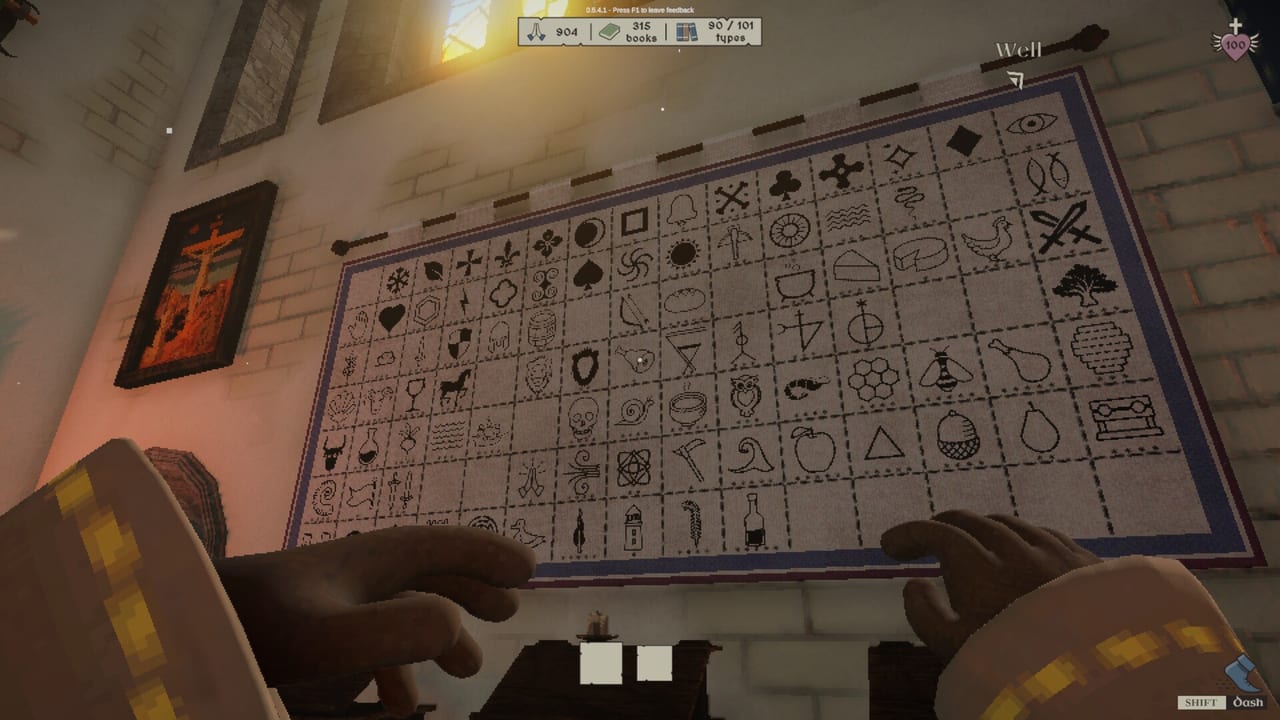
This is a strategy tool, not a web app. It will not draw your shelves, scan your Steam Cloud, or light up a cover you forgot. Monk Took Book already gives you one in-world index: the great tapestry at the back of the main hall, which records symbols you have received. Everything else is a method you bring to Holy Island — mnemonics, paper, and short words in voice chat. If you wanted a clickable grid, use scrap paper. If you wanted a shelf philosophy, pair this page with how to organize.
You cannot read the books. The scribes can. Your information is colour, symbol, size (0.6.3.7 added more silhouettes), and the bay you chose. Night orders arrive as covers, not titles. The planner’s job is to make “green fish, west gallery, third bay, middle plank” a sentence you can say before the 55% four-player clock eats you. See co-op for who should be talking.
What you are actually memorising
A cover is a bundle:
- Pictograph — fish, gate, lightning, goblet, bee, cross, ham, snake, shield, leaf, and dozens more.
- Family — animal, tool, food, faith, weather, geometry, “I do not know.”
- Colour / contrast — useful when two fish exist.
- Size / thickness — large tomes are less common after 0.6.3.7; half-books are narrower. Size is a clue, not a category of its own unless you are desperate.
- Location — room, bay, shelf row, left-to-right slot.
You fail when you memorise 1 without 5, or 5 without a word for 1. “It is upstairs” is not a memory. “Lightning lives in the belfry stair bay, top row, left” is a memory.
Walk the monastery map once in daylight and name the rooms out loud. Dock, main hall, tapestry wall, west gallery, garden door, belfry, checkout, crypt. Those names become memory-palace rooms. Do not use “left” from the dock as a global; left rotates the moment you face the tapestry.
Mnemonic systems that survive a thief
Family shelves. Put every animal in one chamber, every faith symbol in another, food near the garden door, tools near the dock. When a scribe wants a bee, you do not search the abbey; you run to Nature. This is the method most demo streamers invent in twenty minutes, and it scales until two animals share a colour. Split duplicates by colour inside the family, not by a new philosophy.
Story chains. A goblet next to a ham next to a bee is a feast. A gate next to a shield next to a cross is a watch. You remember the sentence, then the bay. Use this inside a family when the bay is long. Do not story-chain across rooms; a Book Thief will steal one word and the sentence dies.
Memory palace on the real floorplan. The abbey is already a palace. Assign each pictograph to a furniture fact: lightning on the high west bay because storms hit the roof, fish on the low bay toward the water, books about fire away from torches (also practical after embers). The palace works when the furniture is real. If you invent a “house from childhood” that is not the monastery map, you will translate under stress and lose the night.
Size as a last pass, not a first. After 0.6.3.7, a tall tome is rarer. You can park large books on the hostile-architecture shelves that want them, and keep half-books in a thin row you can scan. Do not make “big” a family. You will get three big faith books and no idea which is the cross.
The unknown pile. Some symbols will not mean anything. Give them a dedicated “weird” bay near the tapestry so you can compare cloth to spine in five steps. Never scatter unknowns across the island. Night-you will not remember which weird was which.
Rebuild after a fire or a thief. Tattered replacements arrive the next day; the symbol is the same, the location might not be if you reshelved in a panic. A green footprint trail (Book Thief) is a memory tool the enemy dropped on the floor — follow it before you invent a new palace.
How to use the tapestry
The tutorial is explicit: you can see what types you have on the great tapestry at the back of the main hall. It is an index of symbols the barge has given you, not a map of bays. Use it like this:
- After each delivery, walk the tapestry once. Name each new symbol out loud. If you cannot name it, give it a stupid name immediately (“tray-tent,” “ham-flower”). A bad name beats “that one.”
- When a night order looks unfamiliar, run to the tapestry first only if you cannot parse the cover at the desk. The desk is closer to the door; the tapestry is closer to the truth of “have I ever seen this?”
- Do not shelve by tapestry order. The cloth is not a row number. Players who copy the tapestry left-to-right onto one bay create a single point of failure the length of the hall.
- In co-op, one monk can be Tapestry — they stay in the hall, match desk tickets to cloth, and shout a family plus a bay. Runners do not visit the cloth unless the caller is dead or lost.
If you turned enemies off in settings, you still need this pass. The tapestry does not fight. It only remembers what the island has seen.
Paper, notes, and what to write
The game will not stop you taking notes. Paper is legal, and it is how real librarians survived worse catalogues. Write short.
A useful line looks like:
FISH green — west gal / bay 2 / row mid / slot L
A useless line looks like:
The fish book that arrived on the second morning after I unlocked the garden, I think I put it near the other water ones maybe upstairs.
Draw a six-box floorplan: dock, hall, west, garden, belfry, crypt. Put family names in boxes, not fifty pictographs. Add pictographs only for duplicates (two fish). If you are solo, a notepad on the desk is enough. If you are four-wide, one shared doc or a voice note in Discord beats four contradictory pads. Do not pause a public night for a spreadsheet. 0.6.3.7 already shortened the clock.
Phones glare. Use a dim pad or actual paper. Gamma in-game is for the crypt, not for your second monitor’s white table.
Co-op callouts
Agree a grammar before the barge:
- Name, colour, place. “Bee, gold, nature bay, top, two from left.”
- Place uses room names from the map, not “over here.”
- Thief, fire, downed interrupt any cover sentence.
- Tapestry caller owns new symbols. Runners own legs.
- Proximity voice does not reach the crypt. Repeat island-wide facts in text chat (“thief west”) as a backup.
Show monk names in settings. Mute rustle. If a guest is on the demo, they cannot hear you in the paid lobby anyway — fix the App ID before you practise callouts. Players and solo versus co-op describe who should take Speed versus Strength; the planner does not care who is fast, only that the fast monk hears a bay, not an essay.
Spend Blessings on Speed if your palace is large, Carpentry if your palace needs more wood, Strength if you insist on carrying the palace in one stack. Blessings and perk ranks are the muscle; this page is the catalogue. Getting started and how to play teach the bell. Walkthrough is a night order if you want a script. Patch notes explain why sizes multiplied. Launch news will not shelve a fish.
Close this page and draw three bays on scrap paper before you host. The tapestry will not shout a location for you, and the scribes have never learned to wait.
Frequently Asked Questions
Quick answers for novices tending the Holy Island library.
Is this an interactive planner?
No. It is a mnemonic guide. There is no widget, no save import, and no cover database on this wiki.
What does the tapestry show?
Symbols the barge has given you, on the cloth at the back of the main hall. It is an index, not a map of shelf bays.
Should I take paper notes?
Yes if it helps. Write room, bay, row, slot, and a short name. Do not write a paragraph. Four-player clocks are short.
How should co-op call a cover?
Name, colour, place: "green fish, west gallery, bay two, middle, left." Grammar and roles: co-op.
Do extra book sizes change the method?
Size is a hint after 0.6.3.7, not a family. Keep grouping by pictograph family, and park odd silhouettes on shelves that fit. See how to organize.
What if a Book Thief steals a volume?
Follow the green footprints, reshelve, and update the paper line. The tapestry still knows the symbol; only the bay changed.